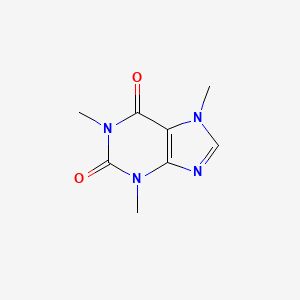
Caffeine
C₈H₁₀N₄O₂
Caffeine (C₈H₁₀N₄O₂) is a central nervous system stimulant found in coffee, tea, and many soft drinks. It is the world's most widely consumed psychoactive substance.
Overview
Caffeine is a xanthine alkaloid compound that acts as a central nervous system stimulant. It is found naturally in coffee beans, tea leaves, cacao pods, and kola nuts. Caffeine works by blocking adenosine receptors in the brain, reducing fatigue and increasing alertness. In its pure form, it is a white crystalline powder with a bitter taste. The molecule consists of a xanthine core (a purine derivative) with three methyl groups attached. Caffeine is rapidly absorbed by the body and has a half‑life of approximately 3–5 hours in adults.
Properties
| IUPAC Name | Caffeine |
|---|---|
| Chemical Formula | C₈H₁₀N₄O₂ |
| Molar Mass | 194.190 g·mol⁻¹ |
| Molecular Geometry | trigonal planar |
| Bond Angle | 120° |
| Polarity | Polar ⚡ |
| Category | Organic |
Geometry
trigonal planar: Trigonal planar — 120° bond angles, atoms at the corners of an equilateral triangle.
Lewis Structure